As John Andrew Holmes wisely said,
"Never tell a young person that something cannot be done. God may have been waiting
centuries for somebody ignorant enough of the impossible to do that thing."

BE SURE TO SCROLL THROUGH AND LOOK THROUGH OLDER POSTS TO SEE
PICTURES OF YOUR CHILDREN AND ALL THEY'RE LEARNING AT
HANDS ON 4 KIDS!!


Sunday, January 22, 2012

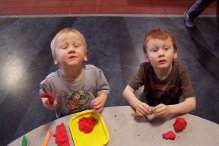
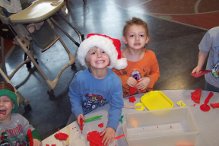
Playing with Play-Doh!

Playing with clay or Play-Doh is a natural outlet through which children can express their emotions and creativity. While working with others,
they are expressing cooperation with one another and creating together.

According to sixtysecondparent.com some of the benefits of Play-dough are:

The benefits of play-dough

  • Helps to strengthen little fingers, hands and wrists.
  • It's fun.
  • It is an open-ended toy - play-dough can be anything - food, animals, bowls, shapes etc.
  • It helps to foster your child's imagination.
  • It helps children develop self esteem -there is no right or wrong and the child has the opportunity to gain mastery over their environment.
  • It is a great release for tension or angry feelings - squeezing, punching, poking are all acceptable if done to playdough.

This fun activity is an open-ended tactile learning experience. Children get a lot of manipulative practice as they squeeze, roll, pinch, cut, shape and pound away. As children play with the Play-Doh, they gain control over hand and arm movements which improves coordination. Play-Doh can be used to review so many learning concepts; letters, numbers, combining, fractions, colors, shapes, etc. These are just a few skills you can review at home with your children while "playing" with Play-Doh!

Wednesday, January 18, 2012

LIVING LOVE AND LOGIC TIP #26

Make Them Part of the FamilyWeekly Tip from the Love and Logic® Experts


One of our basic human needs is to be needed and to be a part of a family. When children live their lives as guests in a four star hotel instead of as a contributing member of a family, this basic need is denied. The usual result is for them to feel increasingly resentful without knowing why. 

One way to help a child feel needed, important, and valued in the family is to put him/her in charge of one family meal per week. See how you can successfully help your child feel a part of the family HERE!

Sunday, January 15, 2012

Compost

It is that time again where we assess the progress in our compost bin. This on-going project is a favorite, as all students participate and contribute to our recycling and reusing of old materials. We love seeing the soil that we have created and cant wait to put it to good use this spring as we plant new things! What a great lesson for children about life cycles and environment.
As stated in the Nevada State preschool standards the 4 main science goals are:

To enhance children’s natural and instinctual observational skills.
To support and guide children’s curiosity and their need to experiment.
To encourage exploration and discovery.
To highlight the wonders of the world around them.
These goals continue to be addressed throughout our science curriculum and the activities that students are engaged in at HO4K.


Students tested their past hypotheses as to which materials would decompose over time and which would not. Here students sort out objects such as a pen, spoon, plastic stickers off the fruit, wipee, paper clip, bracelet, straw, plastic wrapper, ribbon, yarn.....and a plastic cup! These results were concrete and observable, making it easy for the children to draw their own conclusions. These early explorations and experiments will help young children to gain a greater understanding of the world around them.

Wednesday, January 11, 2012

ANNOUNCEMENTS

DANCING WITH MS. JENNY
Please be advised that effective January 2012, Dancing With Ms Jenny Movement and Music Class has been moved to the 4th Thursday of the month from 9:30-10:15 ONLY! If this is not your regularly scheduled day, you are welcome to bring your child and stay during this time.

 Our New Friend
We always love when a new student joins us at HO4K! Students have enjoyed getting to know our new friend. Please make sure to say HI and make him feel welcomed. He is a great addition!

LIVING LOVE AND LOGIC TIP #26

It's a Great Time to Donate Those Older Toys
Weekly Tip from the Love and Logic® Experts
 
The holidays are wrapping up, and chances are, your kids have a whole bunch of older toys they're no longer interested in. By involving our kids in selecting and packing up the toys they'd like to donate, and taking the toys to a local church, synagogue, shelter, etc., we do good for the world and good for our kids. Get the process started in a brief and simple way. To see how go HERE! Good luck!

Monday, January 9, 2012

dance


Students love using their bodies to move to music! Here we are using our bodies to make "snow angels". We practiced moving our bodies slowly, and then fast. Although challenging at times, we worked on moving specific body groups while remaining still with others. The children always enjoy the different music we listen to and love to sing along!
Some of the state standards addressed:


6.PK.1
Identify simple elements of music such as loud/soft and fast/slow.

10.PK.1a
Move in a variety of ways to music to reinforce physical
development basic movements (e.g., over, under, in, out, in
and between).

10.PK.1c
Respond to changes in tempo.

4.PK.1
Engage in daily moderate to vigorous physical activity.
5.PK.1
Participate appropriately during physical activities.

5.PK.2
Demonstrate turn taking and cooperationduring physical activities.
5.PK.3
Interact positively with others regardless of personal differences (e.g., skill level, gender, race, and disability).
1.PK.1
Make a variety of sounds with their voices.

1.PK.2
Create and sing chants.

1.PK.3a
Recognize and select a variety of simple songs, finger plays, musical games, and musical activities alone and with others.


Through dancing and singing, we understand the simple elements of music and demonstrate how to incorporate these elements with both our voices and bodies. We explore our creativity and learn! Its amazing how many of our Creative Expression state standards are addressed when having fun! Make sure to incorporate a little bit of music and dance at home. Your kids will love it!


Friday, January 6, 2012

Rough and Tumble

In her article, "Rough and Tumble Play 101," in the Exchange CD Book Promoting the Value of Play, Frances Carlson points out the reasons to support big-body play in early childhood programs:• "Through the (very) physical interactions required in rough and tumble play, children are learning the give-and-take of appropriate social interactions. Successful participation in this play requires children to become adept at both signaling and detecting signals — a social skill they will need and use throughout their lives. When detecting these signals, they are learning to read and understand the body language signifying the play should come to an end. The play also requires children to alternate and change roles. Sometimes one child chases; at another time the child is chased. Because this give-and-take mimics successful social conversations and interactions, the social roles practiced and learned in rough and tumble play provide children with the social knowledge needed for future relationships.• When children use this big-body play, the intense physical exertion of rough and tumble play also supports cardiovascular health. Through their involvement, young children get the moderate-to-vigorous physical activity needed for optimum physical health. And, because rough and tumble play is so physical, children get many of their vital touch needs met through the play. Because the preschool period is a critical period for children to develop both physically and emotionally, rough and tumble play for preschoolers is invaluable


In explaining why big body play is essential, Carlson observes..."We know that play such as socio-dramatic play, board games, play to explore objects and learn shapes and textures, finger plays and chants to improve self-regulation, and play that involves building things has myriad benefits for children. But the fleeing, tagging, climbing, tumbling, and wrestling that most young children seem to crave is also play and is equally beneficial.As we might assume, there are also abundant positive effects for physical development when children are active in their play. We know, for example, that when teachers involve children in physical exercise with intentional planning, children can practice and develop a variety of physical skills and gain optimum health benefits."But big body play is not just physical activity with physical benefits. During such play, children also use increasingly sophisticated communication skills — both verbal and nonverbal — and social skills. It is also one of the best ways for children (especially boys) to develop empathy and self-regulation. And creativity and thinking skills are enhanced as children determine and solve problems as they arise in the course of this active play."Big Body Play- Why Boisterous, Vigorous, and Very Physical Play Is Essential to Children's Development and Learning." This book explains why the sometimes rowdy, always very physical running, rolling, climbing, tagging, jumping, grabbing, and wrestling that most children love and many adults try to shut down—can and should be an integral part of every early childhood setting. Drawing from evidence-based practice and the latest research, this book explains the multitude of benefits of big body play for young children's social-emotional, cognitive, and physical development.

Nevada Preschool Standards addressed:

2.PK.1 Demonstrate a basic form in walking, running, climbing, jumping, hopping, and walking up and down stairs.
4.PK.1 Engage in daily moderate to vigorous physical activity.
5.PK.1 Participate appropriately during physical activities.
5.PK.2 Demonstrate turn taking and cooperation during physical activities.
5.PK.3 Interact positively with others regardless of personal differences (e.g., skill level, gender, race, and disability).
5.PK.4 Participate in multi-cultural activities that enhance physical development (e.g., dance, games, and activities).

Play is how children find out about their world. All types of play–manipulative play, play with
games, rough-and–tumble play, and socio-dramatic play – provide children with opportunities to try things out, see what happens, and learn (Rubin, Bukowski & Parker, 1998).

Thursday, January 5, 2012

LIVING LOVE AND LOGIC TIP #25

Sad vs. MadWeekly Tip from the Love and Logic® Experts
 
My friend, Dr. Charles Fay, has been known to repeat this phrase: "Sad, not mad."
What does that really mean? Does it mean anger is bad? Does it mean that we should never be angry? I hope not!
Is this little reminder a phrase to help us take better care of ourselves? I hope so!
Angry, wrathful responses send messages that the problem is ours. These reactions put the focus on us (and how upset or mean we are) instead of keeping the focus on the child's unfortunate choice.
When we are sad for kids rather than mad at them, see how the message changes! Go HERE to read more about how to change your message!

Sunday, December 18, 2011

CHRISTMAS BREAK

Just a reminder that Hands-on-4-Kids Preschool will be closed from Monday Dec. 26 thru Monday, Jan 2. Opening again on Tuesday, January 3,2012.

We wish you all a Merry Christmas and a Wonderful New Year full of blessings!

Sunday, December 11, 2011

LIVING LOVE AND LOGIC #28

Questions Create Thinking
Weekly Tip from the Love and Logic® Experts


At Love and Logic® we believe that kids are best prepared for the real world when we allow them to do as much thinking as possible. It's good practice for the real world, and it keeps the monkey off of our backs most of the time.
How do we avoid falling into this trap? One strategy involves using plenty of questions!
To find out how you can help your child become a creative thinker go HERE.

Oranges galore!

Recently, students took a little field trip up the street to visit a neighbor. This friend of ours had a large orange tree that grew from her compost pile. Students were intrigued by this magnificent tree and now have very big expectations of our own compost bin at HO4K. It will be interesting to see what we can grow! We continue our learning in planting, recycling, nutrition and our environment.


Students always love exploring and using their senses. Students observed the tree and the oranges. We compared the leaves, the branches and the sizes of several different oranges. Students loved to smell and taste the oranges. We talked about the different measurements of an orange ie., how heavy, how large, etc.


 We each were able to find and pick our very own orange! This was a tricky choice for some of us!


While taking this trip we have a great opportunity to talk a great deal about safety. The students learned to STOP, LOOK and LISTEN while crossing the street. This is important as we need to be aware of any dangers that are near. We practiced this several times together!


Students also learned about respecting others property. We talked about how the mail in mailboxes is private information that is only to be viewed by the person who lives at that house. Students understand that they are never to look in, or touch mail that does not belong to them.


What a special treat it was to go out and enjoy a nature walk with such a beautiful day! We always have so much fun when we go on our adventures together.